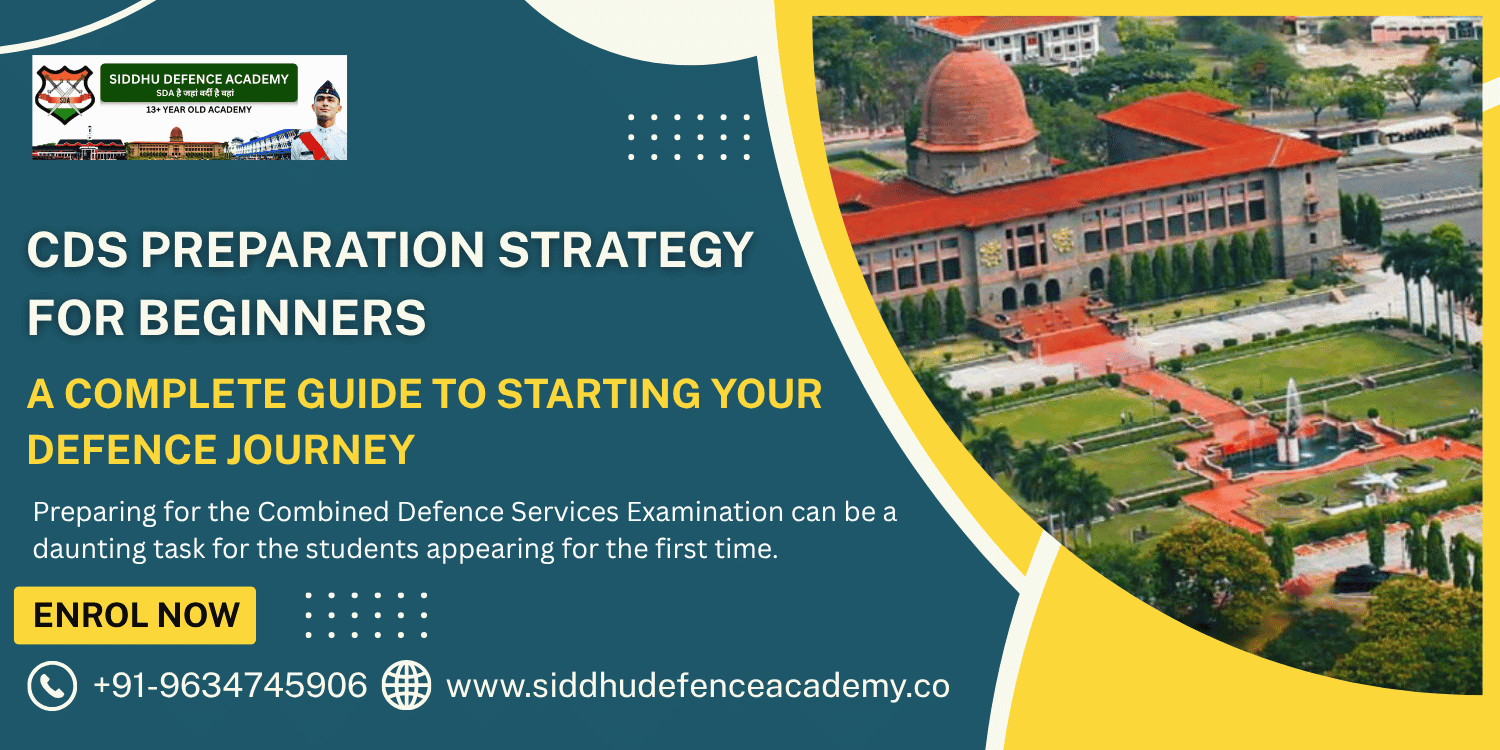
Preparing for the Combined Defence Services Examination can be a daunting task for students appearing for the first time. The syllabus is vast, competition is tough, and the selection process is multi-layered. However, following a clear CDS Preparation Strategy for Beginners, understanding the examination requirements, practising regularly, and maintaining a disciplined approach can help new aspirants build a strong foundation. With proper guidance from a reliable institute offering CDS coaching in Dehradun, beginners can understand the examination process more effectively and prepare with greater confidence.
A well-planned CDS Preparation Strategy for Beginners helps candidates about where to start, how to divide their time, which subjects need attention and how to prepare for the written examination and the Services Selection Board process. Students looking for professional CDS coaching in Dehradun can also avail expert guidance, organized classes, regular assessments and focused learning environment.
First, understand the CDS Examination
Beginners should know the entire selection process before they begin to prepare.
Typically, the CDS selection process includes:
- Written Examination
- Services Selection Board Interview
- Medical examination.
- Final selection on merit
The written examination pattern is different from one academy to another selected by the candidate. Knowing the structure can help aspirants prepare a more focused plan.
Know the Subjects You’ll Study
Candidates should familiarize themselves with the contents of their examination.
I’m going to start with the first part of the question, which is about the relationship between the European Union and the United States, and I’ll come back to the second part later.
Key areas include:
- Grammar Vocabulary
- Reading Comprehension Questions
- Correction of sentence
- Synonyms for DAGGER
- Opposites
- Idioms and phrases
GK / General Knowledge
Preparation usually includes:
- History
- Geography
- Indian Politics
- Economics
- General Science
- Current Affairs
- Defence Awareness
- Elementary Mathematics
Candidates appearing for IMA, INA and AFA generally prepare the following topics :
- Math
- Algebra
- Geometry
- Trigonometry.
- Measurement.
- Statistics.
Random study is a waste of time. Knowing the syllabus prevents that.
Begin with a Preparation Evaluation
For beginners: 1. First, determine your level.
Question yourself:
- What are the top subjects?
- Which subjects are hard?
- How much can be studied per day?
- What do I know about the pattern of examination?
- Now, how fast am I solving questions?
A simple diagnostic test can help find areas needing immediate attention.
Make a Realistic Study Schedule
Your schedule should fit with your daily responsibilities and preparation goals.
A balanced schedule might look like:
- Subject matter study
- Practice questions
- Edit
- Latest news
- Practice exams
- Exercise (Physical)
Beginners should not make a plan that they will not be able to follow after a few days. It is better to study a little than to study a lot for a little time.
Build a Strong Foundation
Students should start with the simple concepts before attempting to solve the advanced questions.
For Maths
Concentrate on:
- Basic equations
- Easy calculations
- Concept clarity
- Simple problem solving
- Now for English
Begin with:
- Basic rules of grammar
- Common language
- Practice reading
- GK General knowledge for
Begin with fundamental information on history, geography, science, politics, and current events.
Preparation is easier with a solid foundation.
Implement Subject-Based Approach
Each subject demands a different approach.
Tips for English Preparation
Read regularly,
- revise grammar rules,
- learn vocabulary
- solve objective questions.
Strategy for Preparing General Knowledge
Merge static topics with daily current affairs preparation.
Strategy for Preparing Mathematics
Learn the concepts first, then practice questions of increasing difficulty.
This subject-wise approach will prevent you from preparing unevenly.
Practice Daily
Preparation for competitive examinations requires regular practice.
Students will:
- Solve daily questions
- Ask different kind of questions
- Establish time limits
- Review Errors
- Hard subjects to repeat
Practice daily to improve your speed and accuracy gradually.
Use of last year’s question papers
Old Year Question Papers help the beginners to know the real examination level.
They provide details on:
- Most commonly tested topics
- Question level
- Subjects’ distribution
- Time requirements
- Typical questions
Solving past years’ papers should be a preparation routine.
Start with Mock Tests.
If you are new to this, don’t try to do a whole test straight away.
A better way is to:
- Start with subject-wise tests.
- Switch to chapter-based assessments.
- Try the papers at the subject level.
- Full-length mock exams.
This slow approach allows students to gain confidence.
Review Your Errors
It is not enough just to pass a test.
After each test, confirm:
- Why was the answer wrong?
- Was the thought vague?
- You misunderstood the question?
- Were there calculation errors?
- Was there too much time spent?
Students can avoid repeating the same mistakes with the help of mistake notebooks.
Time Management Enhancement
The CDS exam is a fixed-time duration exam, so candidates will have to work efficiently.
Time management improves with:
- Timed practice
- Sample Tests
- Selection of questions
- Periodic review.
- Speed work
Students need to learn to leave questions which take too long.
Build a Current Affairs Habit
“Don’t study current affairs just before the examination.
Beginners will be able to:
- Read trusted news sources
- Stay current with the latest news
- Study defense updates related
- Monthly current affair compilation
- Write brief notes
Regular revision makes information easier to recall.
Start SSB Preparation early
The written examination is only one component of the CDS selection process.
Candidates have to evolve gradually:
- Communication skills
- Confidence
- Leadership
- Teamwork
- Decision making
- Awareness
Personality development can be helped through activities like group discussion, presentation, reading and public speaking.
Stay in Shape
A defence aspirant should lead an active life.
Some regular activities could be:
- Running —
- Strength training
- Stretched out
- Nature’s activities
- Endurance exercise
Physical fitness aids in health, confidence, and future defence training.
How CDS Coaching in Dehradun Can Assist Beginners
Newcomers often have no idea where to start. Professional CDS coaching in Dehradun can give you a structured direction.
Students may be given:
- Specialist faculty mentoring
- Structured classroom learning
- Study Materials
- Regular testing
- Help clearing doubt
- Analysis of performance
- Planning of revisions
- SSB guidance
Such help can avoid common errors beginners make in preparation.
Common Mistakes for Beginners
New aspirants, stay away:
- Learning without a plan
- Skipping the syllabus.
- Overuse of resources
- Avoiding the hard questions
- Revision skip
- Not solving old papers
- Sample test ignored
- SSB preparation postponed
- Disregarding physical fitness
A directed effort yields better results than wandering efforts.
A Practical Study Routine for Beginners
A basic preparation routine might consist of:
Mornings
- Reading current affairs
- Vocabulary revision
- Physical activity
12:00 Noon
- Mathematics or a different core subject
- Learning Concepts
- Practice Problem
- English prep
evening
- Practice on General Knowledge
- Review of last topic
- Weekly
- Mock test
- Mistake analysis
- tracking progress
Students can modify the routine based on their own schedules.
Reasons to Choose Siddhu Defence Academy
Siddhu Defence Academy offers a systematic environment for aspirants preparing for the CDS exam.
The academy provides:
- Competent faculty
- Teaching in the classroom
- New study materials
- Periodic mock tests
- Doubt-clearing sessions
- Revisions Support
- Performance analysis:
- Development of personality
- Fitness advice
- Career Counseling
- SSB Preparation
This consolidated approach ensures that the beginners are guided every step of the preparation journey.
CDS Advanced Preparation Techniques for Beginners
Set monthly goals
For beginners, the whole process of preparation should be divided into smaller monthly targets.
A monthly plan might consist of:
- Topics Completed (Selected) in the Syllabus
- Completing a certain number of practice questions
- Finishing last year’s papers
- Improving marks in mock tests
- Keeping up with the news
- Reinforcing weak subjects
“Smaller targets are easier to manage and monitor on a long journey of preparation.
Set up a personal revision system
Each candidate should develop a method of revision that suits their learning style.
Helpful techniques are the following:
- Brief revision notes
- Formula sheets
- wordlists
- Notebooks on Current Event
- Topic synopses
- Logs errors
It’s good to review on a regular basis in order not to forget what you have already learned.
Learn to Give Priority to Important Subjects
Beginners should not spend the same amount of time on each topic.
A practical approach is to look for the following:
- Commonly Asked Topics
- Hard chapters
- High scoring areas
- Subjects in need of several practice
- Personal shortcomings
This helps candidates to make the best of their available preparation time.
Increase Reading Speed
In English and General Knowledge preparation, reading speed affects performance.
Students could work on:
- Reading the papers
- Reading Articles
- Review of opinion pieces
- Practice comprehension passages
- Summarising key information.
Reading regularly helps with better understanding and helps candidates process the questions quickly.
Practice Choosing Questions Wisely
Competitive exam aspirants must manage their time well.
Students should learn to: in practice:
- Find the simple questions
- Don’t guess a lot
- Prevent complicated problems
- Return to the difficult questions later
- Make sure a correct
This strategy can help candidates to attempt the paper in a better way.
Build Strong Defensive Awareness
Aspirants should be interested in the developments related to National Security and Defence.
Useful areas are
- Indian military forces
- Exercises
- Military technology
- Key commands
- National security
- Important defence accords
- Military decorations
This knowledge can be useful for General Knowledge preparation and future SSB discussions.
Build Confidence with Communication
Many beginners are shy to speak in front of others. Regular practice can gradually get rid of this hesitation.
The students can improve by:
- Commenting on current issues
- Discussion Participation
- Making brief presentations
- Reading aloud
- Respectfully shared opinions
Good communication will help you in the SSB process as well as in your future profession.
Keep a Healthy Competitive Mindset
Competition should motivate students rather than put undue pressure on them.
Here is a healthy approach:
- How performance is today vs how it was in the past
- Learning from the better students
- Mistakes Welcome
- Celebrating small wins
- Staying focused on your personal goals
Progress must be measurable and have continuous improvement.
Pick the Right Study Materials
There are too many books and Internet resources that can be confusing.
Beginners should concentrate on:
- Dependable textbooks
- Good practice material
- Old question papers
- Latest current affairs news
- Reliable practice tests
Usually, a limited number of good resources will do more good than gathering too many.
Controlling Stress During Preparation
Long term preparation can be hard on the mind sometimes.
Students can deal with pressure by:
- Take many breaks
- Physical activity
- Sleep well
- Healthy food
- Activities outside
- Family Time
- Positive talk
A calm mind helps us to focus and learn better.
Analysis of Mock Test Performance
Keep track of mock test scores over a period of time.
Students can monitor:
- Total Marks, Subject-wise Marks
- Accurate
- Questions attempted
- Duration
A performance chart can indicate whether the preparation is going in the right direction.
Learn from Each Test
Every test is feedback.
When students finish a paper, they should identify the following:
- Knowledge gaps
- Mathematical mistakes
- Problems with time management
- Misunderstood questions.
- Subjects to be revised
Each test becomes a learning experience in the process.
Persevere in Difficult Times
Sometimes it can be slow or frustrating to prepare. Students should keep in mind that improvement is not always immediate.
Candidates should:
- Follow the schedule further
- Revise regularly.
- Ask for help if you need it
- Remove distractions
- Hang in there.
Consistent effort takes time to show results.
Develop Leadership Through Everyday Practice
Ordinary responsibilities can be used to develop leadership qualities.
Students can practice leadership by:
- Responsibility for duties
- Helping other students
- Engaging in group activities
- Making sound decisions
- Listening to others
- Striving together for shared goals
These experiences can result in personal growth.
Get ready for the full selection journey
A beginner should not think only of passing the written examination.
The preparation process should be complete, including:
- Knowledge for academic
- Fitness (physical)
- Communication
- Self-confidence Leadership
- General knowledge
- Development of emotions
This wider view prepares students for the demands of a defence career.
How newcomers benefit from expert support
Students often lose valuable time because they do not know the right sequence of preparation. When you opt for professional CDS coaching in Dehradun, you get a well-defined path from the basics to the higher levels of practice.
Guidance helps students to:
- Understand the syllabus
- Pick useful resources
- Design study plans
- Finding weak spots
- Prepare with regular testing
- Refine methods of examination
- Develop traits of character
With the right guidance, beginners can avoid unnecessary confusion and develop a more efficient routine.
Last Words for New Aspirants
A beginner doesn’t have to know everything on the first day of preparation. The most important step is to start with a clear plan and keep learning consistently.
Students need to focus on:
- Comprehending ideas
- Practicing regularly
- Returning to key issues
- Learning from Errors
- Enhanced communication
- Getting fit
- Self-discipline Developing
Success is a journey, and it requires patience and dedication. A well-planned CDS Preparation Strategy for Beginners can help you convert your uncertainty in the beginning into confidence in your preparation. The aspirants can gradually develop the academic knowledge, confidence, and qualities required for the CDS selection process through consistent hard work and a positive attitude with the right guidance.